
Food has always been more than sustenance—it is memory, identity, and ceremony served on a shared plate. Yet in today’s rush for convenience, many of the communal and spiritual dimensions of cooking are fading into the background. This article moves beyond ingredients and techniques to explore how traditional cooking rituals transform meals into meaningful cultural expressions. Drawing from extensive global culinary exploration, we uncover the stories, customs, and sacred practices that shape how communities celebrate, honor, and connect through food. If you’re seeking to understand how culture lives and breathes through the kitchen, you’re in the right place.
The Pachamanca: An Earth Oven Feast in the Andes
As we explore the rich tapestry of traditional cooking rituals still practiced today, we inevitably encounter the foundational elements that contribute to these time-honored methods, including the nuanced flavor profiles of sweet, sour, salty, bitter, and umami that elevate each dish – for more details, check out our Understanding Flavor Profiles: Sweet, Sour, Salty, Bitter, and Umami.
The Pachamanca is more than a meal—it’s a tribute to Pachamama, or Mother Earth, and one of Peru’s most treasured traditional cooking rituals. The word itself comes from Quechua: pacha (earth) and manca (pot). Instead of metal pans or ovens, cooks use the ground as their cooking vessel. The result? A feast infused with smoke, soil, and story.
So how does it work? First, a pit is dug into the earth. Stones are heated over a wood fire until they’re scorching hot (think nature’s version of a pizza oven). Meanwhile, meats—often lamb, pork, chicken, or alpaca—are marinated with herbs like huacatay, garlic, cumin, and chiles. Next comes layering: hot stones at the base, then meats, potatoes, sweet potatoes, corn, and fava beans. More heated stones go on top, followed by banana leaves or cloth, and finally earth to seal in the heat. In about an hour, the underground oven works its magic.
Importantly, Pachamanca is a community event. Families and neighbors gather to prep ingredients, tend the fire, and eventually uncover the feast together. If you’re planning one, assign clear roles—fire keeper, prep cook, pit supervisor (pro tip: organization prevents overcooking).
The flavor is unmistakable. The hot stones sear while the trapped steam tenderizes, creating smoky, earthy notes that modern kitchens simply can’t replicate. Some argue you could mimic it with a smoker. Technically, yes—but without the soil, the ceremony, and the shared labor, it’s just dinner, not Pachamanca.
Mochi-Tsuki: Pounding Rice for Japanese New Year
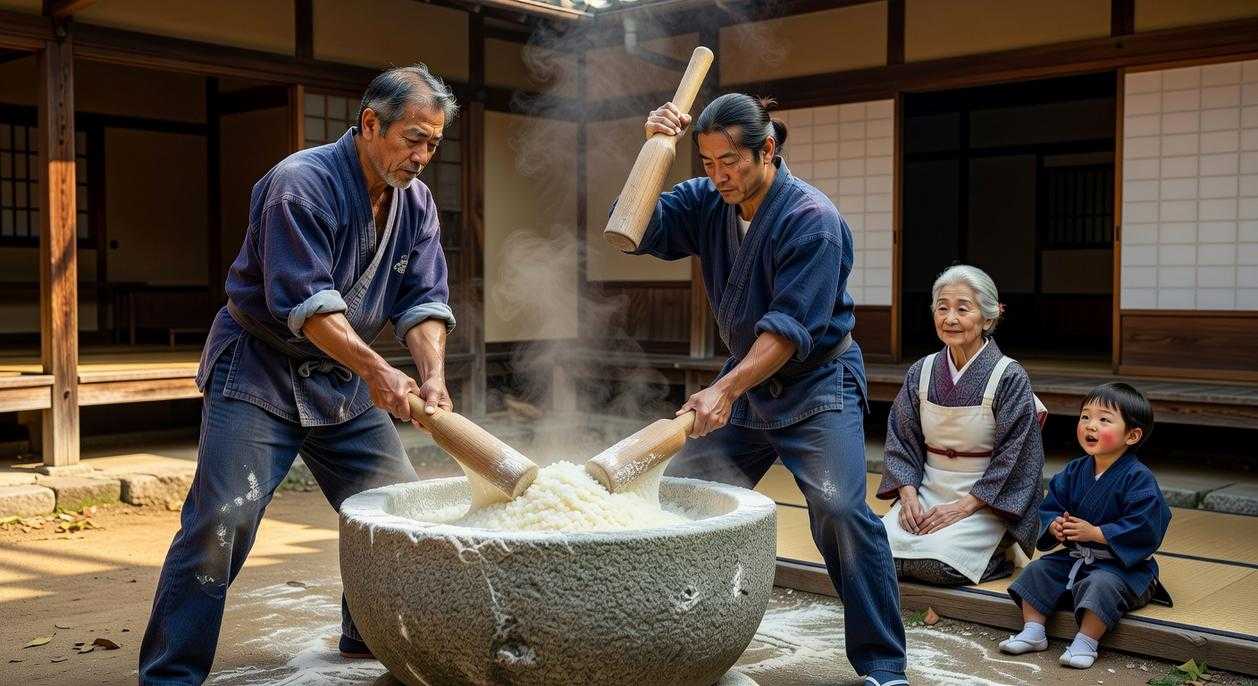
Mochi-Tsuki is more than a cooking method; it’s a celebration in motion. Each New Year (Oshogatsu), families and communities gather to pound glutinous rice into mochi—soft, elastic rice cakes that symbolize renewal and prosperity. For participants, the benefit is immediate and lasting: you don’t just make food, you create connection. In a fast-paced world, this pause for shared effort feels grounding (and surprisingly therapeutic).
At the center of the ceremony are two essential tools: the usu, a large stone or wooden mortar, and the kine, a hefty wooden mallet. However, the magic lies in teamwork. One person pounds rhythmically while the other swiftly turns and wets the rice between strikes. Timing is everything. Done well, it’s like a perfectly choreographed dance—miss a beat and you’ll know. This coordination builds trust and unity, skills that extend far beyond the kitchen.
As the steamed rice transforms from loose grains into a smooth, stretchy dough, you witness a powerful metaphor: steady effort yields beautiful results. The finished mochi is shaped into kagami mochi, stacked offerings placed on household altars to invite good fortune. Participating gives families a tangible way to express hope for the year ahead.
Some argue it’s easier to buy mochi at a store. True—but you lose the shared labor that strengthens bonds. Much like the street food traditions that define cities around the world, Mochi-Tsuki proves food rituals nourish more than hunger. In preserving traditional cooking rituals, you gain heritage, harmony, and a sweeter start to the year.
The first time I was invited to an Ethiopian coffee ceremony, I thought we were simply having a drink. Instead, I stepped into Buna, a ritual that unfolded like theater. First, green beans were washed and roasted over an open flame, and soon the room filled with a smoky, buttery aroma that felt almost sacred. Then, the beans were ground by hand, their crackle echoing softly, before being brewed in a rounded clay pot called a jebena. More than a beverage, this hours-long gathering is a cornerstone of social life.
Next, came the three cups: abol, tona, and baraka. Each round grew lighter in flavor yet deeper in meaning, symbolizing transformation and blessing. As conversation stretched, stories surfaced, disagreements softened, and laughter lingered.
Some might argue it is inefficient in a fast-paced world; however, that unhurried rhythm is precisely the point. Being invited signals respect and friendship, and the ceremony preserves traditional cooking rituals while strengthening community bonds. Ultimately, time seems to slow, reminding everyone that connection, like coffee, is best savored slowly. Pro tip: accept the third cup, even if you are full, because declining baraka can be seen as turning away shared goodwill. It completes the circle beautifully.
Bringing heritage home starts with a conversation. Ask your grandparents what simmered on the stove during Lunar New Year in Flushing or Sunday suppers in Baton Rouge. Those details—cast-iron skillets, banana leaves from the Queens night market—anchor memory in place.
Commit to one slow evening each week. Choose a dish that demands patience: hand-folded pierogi, low-and-slow Texas brisket, or dal tempered in hot ghee. Slow food isn’t trendy jargon; it’s a mindset that values time as an ingredient (yes, even when takeout tempts you).
Shop with intention at neighborhood mercados or H Mart aisles. Vendors will explain why a specific masa grind or fish sauce brand matters in traditional cooking rituals, saving you from rookie mistakes.
Finally, serve the story alongside the meal. Context turns dinner into dialogue—part history lesson, part potluck diplomacy. Pro tip: jot down family recipes before they disappear. Stories season food more deeply than salt ever.
The Enduring Power of a Shared Meal
From the earth ovens of Peru to the ceremonial coffee of Ethiopia, you’ve seen how food preparation is a profound cultural act. These traditional cooking rituals prove that food is our most universal language of heritage and connection. Don’t let that meaning fade. The next time you cook, honor the story behind your ingredients. Join thousands of passionate home cooks who are preserving culture one delicious, intentional meal at a time.
 Zayric Orlandis is the kind of writer who genuinely cannot publish something without checking it twice. Maybe three times. They came to recipe adaptation ideas through years of hands-on work rather than theory, which means the things they writes about — Recipe Adaptation Ideas, Global Food Fundamentals, Hinga Flavors and Traditions, among other areas — are things they has actually tested, questioned, and revised opinions on more than once.
That shows in the work. Zayric's pieces tend to go a level deeper than most. Not in a way that becomes unreadable, but in a way that makes you realize you'd been missing something important. They has a habit of finding the detail that everybody else glosses over and making it the center of the story — which sounds simple, but takes a rare combination of curiosity and patience to pull off consistently. The writing never feels rushed. It feels like someone who sat with the subject long enough to actually understand it.
Outside of specific topics, what Zayric cares about most is whether the reader walks away with something useful. Not impressed. Not entertained. Useful. That's a harder bar to clear than it sounds, and they clears it more often than not — which is why readers tend to remember Zayric's articles long after they've forgotten the headline.
Zayric Orlandis is the kind of writer who genuinely cannot publish something without checking it twice. Maybe three times. They came to recipe adaptation ideas through years of hands-on work rather than theory, which means the things they writes about — Recipe Adaptation Ideas, Global Food Fundamentals, Hinga Flavors and Traditions, among other areas — are things they has actually tested, questioned, and revised opinions on more than once.
That shows in the work. Zayric's pieces tend to go a level deeper than most. Not in a way that becomes unreadable, but in a way that makes you realize you'd been missing something important. They has a habit of finding the detail that everybody else glosses over and making it the center of the story — which sounds simple, but takes a rare combination of curiosity and patience to pull off consistently. The writing never feels rushed. It feels like someone who sat with the subject long enough to actually understand it.
Outside of specific topics, what Zayric cares about most is whether the reader walks away with something useful. Not impressed. Not entertained. Useful. That's a harder bar to clear than it sounds, and they clears it more often than not — which is why readers tend to remember Zayric's articles long after they've forgotten the headline.